
You brush twice a day, floss most nights, and still hear your hygienist mention “buildup” at every cleaning. Plaque and tartar are two of the most common reasons dentists talk about cavities and gum disease, and it’s easy to mix them up. They’re related but not the same, and they require different treatment. Knowing the difference helps you protect your teeth before small problems turn into expensive ones. The simplest way to remember: plaque is the beginning, and tartar is what happens when plaque is left behind.
This guide covers what each one is, how plaque turns into tartar, how to tell them apart, and what to do about both.
Plaque vs Tartar: Key Differences at a Glance
Here’s how the two compare in everyday terms:
| Feature | Plaque | Tartar |
| Texture | Soft and sticky | Hard and rough |
| Color | Clear to pale yellow | Yellow, tan, or brown |
| Removal | Brushing and flossing | Professional cleaning |
| Formation | Builds up quickly | Forms when plaque mineralizes |
| Main concern | Cavities and gingivitis | Ongoing gum inflammation |
What Is Plaque?
Plaque is a soft, sticky film made up of bacteria, saliva, and leftover food particles. It starts forming on your teeth within hours of your last brushing, which is why your teeth feel “fuzzy” when you wake up or go too long between cleanings.
What Plaque Looks and Feels Like
Plaque is usually colorless or pale yellow, so it’s hard to see. You can feel it with your tongue as a slightly slimy or fuzzy coating, especially near the gumline and between teeth. Many people never notice it until it has caused damage.
Why Plaque Causes Problems
The bacteria in plaque feed on sugars and starches from your food and drinks. As they feed, they release acids that wear down tooth enamel. Over time, that acid attack leads to cavities. Plaque bacteria also irritate the gums, causing redness, swelling, and bleeding when you brush.
The good news is that you can remove plaque at home. Thorough brushing and daily flossing disrupt it before it can harden.
What Is Tartar?
Tartar, also called dental calculus, is hardened plaque. When plaque stays on your teeth, minerals in your saliva, such as calcium and phosphate, gradually deposit into it. The soft film mineralizes into a rough, cement-like crust that bonds firmly to the tooth surface.
What Tartar Looks and Feels Like
Tartar is easier to spot than plaque. It typically appears yellow, tan, or brown, and it feels rough or bumpy when you run your tongue over it. It often collects behind the lower front teeth and on the outer surfaces of the upper back molars, because these areas sit close to the openings of your salivary glands.
Why Tartar Is More Serious
Tartar’s rough surface gives new plaque an ideal place to grab hold, so buildup speeds up. It also sits along and below the gumline, keeping the gums inflamed. Left alone, it can contribute to gum recession, persistent bad breath, and periodontitis, a more advanced form of gum disease that can damage the bone supporting your teeth.
How Plaque Turns Into Tartar
Plaque doesn’t need long to start hardening. In some people, it begins to mineralize within 24 to 72 hours if it isn’t removed. That’s why daily cleaning matters so much. Skip a few days of thorough brushing and flossing, and soft plaque can begin to lock into place.
Some people form tartar faster than others. Saliva chemistry, genetics, and the shape and position of your teeth all play a role, which explains why one person can brush carefully and still build up tartar while another seems to get away with less effort.
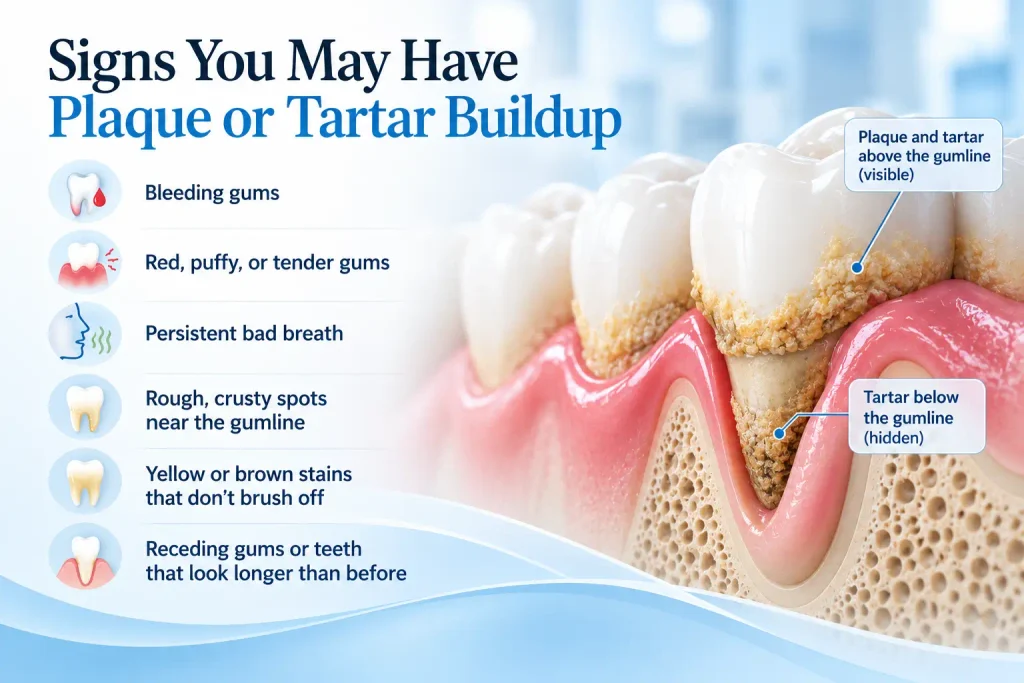
Signs You May Have Plaque or Tartar Buildup
Because both can develop quietly, it helps to know the warning signs:
- Gums that bleed when you brush or floss
- Red, puffy, or tender gums
- Persistent bad breath or a bad taste that doesn’t go away
- Rough, crusty spots near the gumline
- Yellow or brown stains that don’t brush off
- Receding gums or teeth that look longer than before
Tartar above the gumline is often visible. Tartar below the gumline usually isn’t visible and is typically detected during a professional dental or periodontal examination.
How to Remove Plaque
Since plaque is soft, your daily routine is your best defense:
- Brush twice a day for two minutes with fluoride toothpaste. Angle the bristles toward the gumline and use gentle, short strokes.
- Floss once a day, or use interdental brushes or a water flosser if string floss is hard for you. Brushing alone can’t reach the tight spaces between teeth.
- Replace your toothbrush every three months, or sooner if the bristles look frayed.
- Limit sugary snacks and drinks, especially sipping throughout the day, which gives bacteria a constant food supply.
- Consider an antibacterial mouthrinse if your dentist in Reston, VA recommends one.
An electric toothbrush with a pressure sensor can also help, since many people brush too hard or miss spots without realizing it.
How to Remove Tartar
Here is where expectations need a reality check. Once tartar has formed, brushing and flossing won’t remove it, no matter how hard you scrub. The deposit is bonded to the tooth and must be removed with specialized instruments.
Professional Dental Cleaning
During a cleaning, your hygienist uses an ultrasonic scaler and hand instruments to break up and lift tartar from the tooth surface and from just beneath the gumline. This procedure is called scaling, and it is quick and routine for most patients. If gum disease has already set in, your dentist may recommend a deep cleaning known as scaling and root planing.
Why Home Remedies Fall Short
You may see claims online about baking soda, vinegar, or lemon juice dissolving tartar. These methods are unreliable, and acidic or abrasive mixtures can wear away enamel and irritate your gums. Scraping at tartar with a metal pick at home is just as risky, since it can scratch the tooth and injure the gums. Leave tartar removal to a professional.
How to Prevent Tartar From Forming
You can’t remove tartar yourself, but you can make it much harder for it to form:
- Brush and floss consistently, especially before bed, when saliva flow drops and bacteria thrive.
- Try a toothpaste labeled for tartar control. These formulas can slow new buildup, though they won’t dissolve existing tartar.
- Pay extra attention to the backs of your lower front teeth and the outer surfaces of your upper molars.
- Quit smoking or vaping. Tobacco use is linked to faster tartar buildup and a higher risk of gum disease.
- Keep up with regular checkups and cleanings. Most people do well with a visit every six months, though your dentist may suggest a shorter interval if you build up tartar quickly or have a history of gum problems.
When to See a Dentist
Book an appointment sooner rather than later if your gums bleed regularly, your breath stays unpleasant despite good hygiene, or you notice hard deposits you can’t brush away. Early treatment is simpler, more comfortable, and less costly. Gingivitis, the earliest stage of gum disease, is usually reversible once you remove buildup and improve home care.
Gingivitis is usually reversible with professional care and improved home hygiene, while periodontitis is a more serious condition that requires ongoing treatment and management.
Final Thoughts
Understanding plaque vs tartar comes down to one idea: plaque is soft and removable at home, while tartar is hardened and needs a professional. Everything else follows from that. Consistent daily care keeps plaque from ever reaching the tartar stage, and regular cleanings take care of whatever slips through.
If you’ve noticed rough spots, stubborn stains, or bleeding gums, don’t wait for pain to show up. A simple cleaning can reset your mouth and give you a clear plan for keeping it that way.