
If you want wisdom tooth removal in Reston, then you may see a general dentist or an oral surgeon. A general dentist can frequently remove wisdom teeth that have completely come in or are easy to reach. They can review to your teeth or X-rays just to determine whether removal is straightforward.
An oral surgeon has distinct training to treat teeth or jaws and the face. They often handle more complex cases, such as wisdom teeth stuck under the gum or bone, growing at an unusual angle, or near nerves. A dentist Reston VA can check to your wisdom teeth and refer you to an oral surgeon if you want more complex treatment.
When Can a General Dentist Remove Wisdom Teeth?
A general dentist may eliminate a wisdom tooth when it is easy to reach or remove. It just depends on the tooth’s position, roots or the dentist’s involvement.
A general dentist may remove it when:
- The wisdom tooth is fully erupted.
- The tooth is easy to reach.
- The tooth is in a usual position.
- The roots look simple.
- There is sufficient space to remove the tooth securely.
- The extraction does not require complex surgery.
For example, if a wisdom tooth has entirely come out or is standing normally then a general dentist may be able to remove it. An X-ray helps the dentist just to check out the roots and nearby areas before the extraction.
The key point is that extraction difficulty matters more than the fact that it is a wisdom tooth. After checking your mouth or X-ray, your dentist can decide whether they can safely remove it later.
When Should You See an Oral Surgeon in Reston?
You may want an oral surgeon in Reston if your wisdom tooth extraction is difficult, your wisdom tooth is hard to remove, or it hasn’t grown in properly. Oral surgeons have distinct training for difficult tooth extractions. Your dentist may recommend one after checking your teeth and X-rays.
An oral surgeon may be a good choice when:
Wisdom teeth are impacted: The tooth is stuck below the gum or can’t come out normally.
A tooth is under the gum or bone: Surgery may be required to remove it securely.
The tooth is growing at a difficult angle: A sideways or oddly placed tooth can be tougher to remove.
The roots are complicated: Long, curved, or unusual roots can make removal more difficult.
The tooth is close to important nerves: X-rays can show whether the wisdom tooth is near a nerve and needs extra care.
You may need stronger sedation: An oral surgeon may recommend more sedation options for nervous patients or complex procedures.
Many Reston oral surgery practices propose wisdom tooth removal and action for impacted teeth. However, not every impacted wisdom tooth needs an oral surgeon. The correct option depends on the tooth’s position, roots, and how difficult it is to remove.
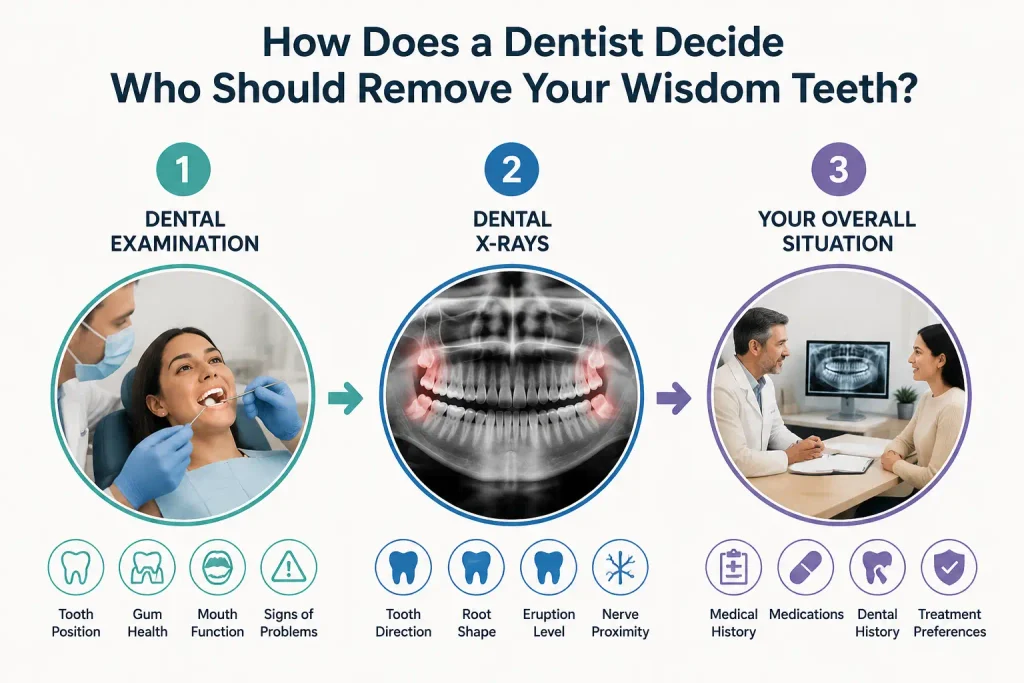
How Does a Dentist Decide Who Should Remove Your Wisdom Teeth?
The correct person to remove your wisdom teeth depends on your teeth and your overall dental health. Your dentist or oral surgeon will check out a few things just before deciding what is best for you.
1: Dental Examination
First, the dentist will check your mouth. They may look at:
- Where the wisdom tooth is growing
- The gums around the tooth
- How well you can open your mouth
- Symbols of infection or other dental complications
Your symptoms are too important. Pain or swelling, infection or trouble cleaning the area may disturb the treatment plan.
2. Dental X-Rays
An X-ray helps the dentist see what a routine checkup can’t. It can show:
- The direction of the tooth
- The shape of the roots
- How much of the tooth has come through
- How close the tooth is to nearby nerves and other structures
For more complex cases, an oral surgeon may use a 3D scan such as a cone-beam CT scan to plan the procedure.
3. Your Overall Situation
The dentist may also ask about your:
- Medical past
- Medications you take
- Dental anxiety
- Previous dental experiences
- Preferences about anesthesia or sedation
This information helps the dental team decide who should remove the wisdom tooth, where the procedure should happen, and which technique is safest for you.
Should You Start with a General Dentist or Go Directly to an Oral Surgeon?
For many people, starting with a general dentist in Reston is one good option. The dentist can check your wisdom teeth, review your X-rays, or determine whether the tooth can be removed easily. If the case is more complex, then the dentist may refer you to an oral surgeon.
For many patients:
See a general dentist: The dentist will check your wisdom teeth.
Review the X-rays: The dentist will examine the tooth, roots, and nearby areas.
Get a referral if needed: If the tooth is hard to remove, then the dentist may refer you to an oral surgeon.
You can also see an oral surgeon directly if you previously know that your wisdom teeth are impacted or another dentist has told you to get a specialist.
The right option depends on your tooth’s position or how difficult it may be to remove. A dental exam can help you choose the best provider.
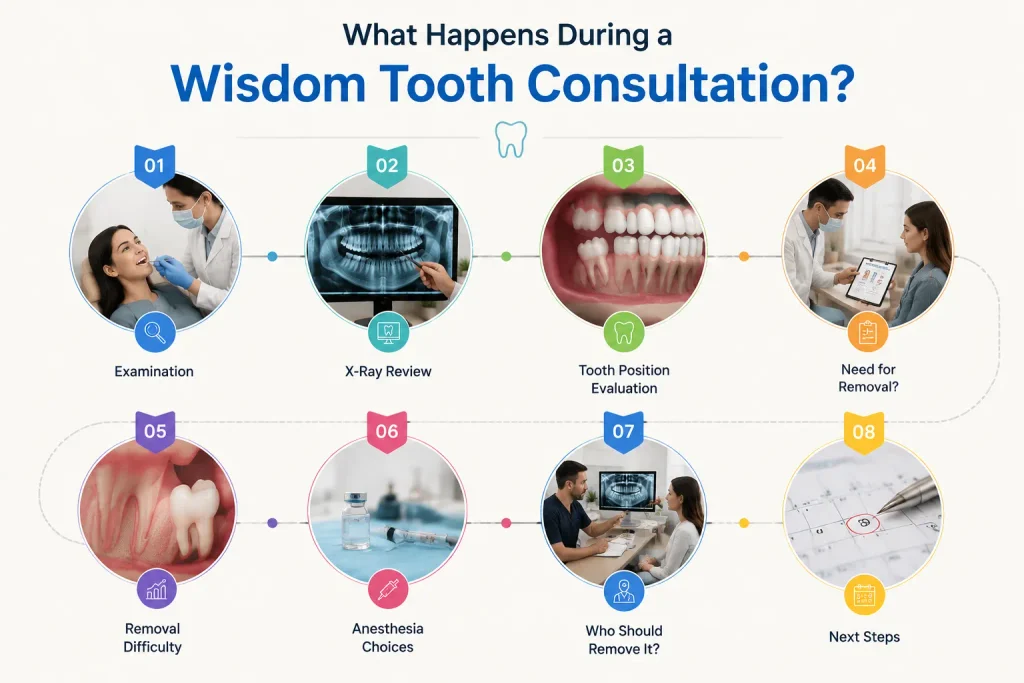
What Happens During a Wisdom Tooth Consultation?
A wisdom tooth consultation helps the dentist understand your problem. The dentist will check your teeth and ask about any pain or other symptoms. They will also review your X-rays or clarify what treatment you want.
The dentist or oral surgeon may:
- Check your teeth and gums.
- Look at your dental X-rays.
- Take new X-rays if required.
- Check the position of your wisdom teeth.
- Tell you if the tooth needs to be removed.
- Clarify how easy or tough the removal may be.
- Talk about anesthesia or sedation choices.
- Tell you if a general dentist or oral surgeon should remove the tooth.
At the end of the visit, you should know why the treatment is needed and who should perform it. This can help you feel more comfortable and ready for the next step.
Questions to Ask Before Choosing a Wisdom Tooth Dentist
If you are choosing between a general dentist and an oral surgeon in Reston, you should ask a few simple questions first. This can help you to understand why a certain treatment is suggested.
You can ask:
- Do you frequently remove wisdom teeth?
- Are my wisdom teeth completely grown in or impacted?
- What does my X-ray show?
- Will the tooth removal be simple or tough?
- Why do I want to see an oral surgeon?
- What kind of anesthesia or sedation can I have?
- Will I want a referral?
- Will you clarify all my treatment selections before the process?
These questions can help you choose a dentist based on their experience and your dental goals, not just proximity.
Conclusion:
To summarise, choosing the right provider for wisdom tooth removal Reston depends on your teeth and how difficult they are to remove. A general dentist can often remove a simple, fully erupted wisdom tooth. An oral surgeon may be a better option for impacted teeth, hard-to-reach teeth, unusual positions, or cases that require sedation.
If you are not sure that where to go, please start with a dental checkup. Your dentist can review your X-rays or tell you whether they can remove the tooth or if you should see an oral surgeon. The key goal is to select a provider who can remove your wisdom teeth safely and easily.
FAQs About Wisdom Tooth Removal in Reston
Can a regular dentist remove wisdom teeth?
Yes. A general dentist can remove simple wisdom teeth. Difficult cases may require an oral surgeon.
Do all wisdom teeth need an oral surgeon?
No. A general dentist can frequently remove simple teeth. Complicated cases may need a specialist.
How do I know if my wisdom teeth are impacted?
A dentist can use an exam and X-ray to check if the tooth is stuck below the gum or bone.
Can I choose an oral surgeon without a referral?
It depends on the office and your insurance. Call the office to ask whether you need a referral.
How much does wisdom tooth removal cost in Reston?
The price depends on the tooth or treatment, anesthesia, or insurance. Ask your dentist for an exact estimate.